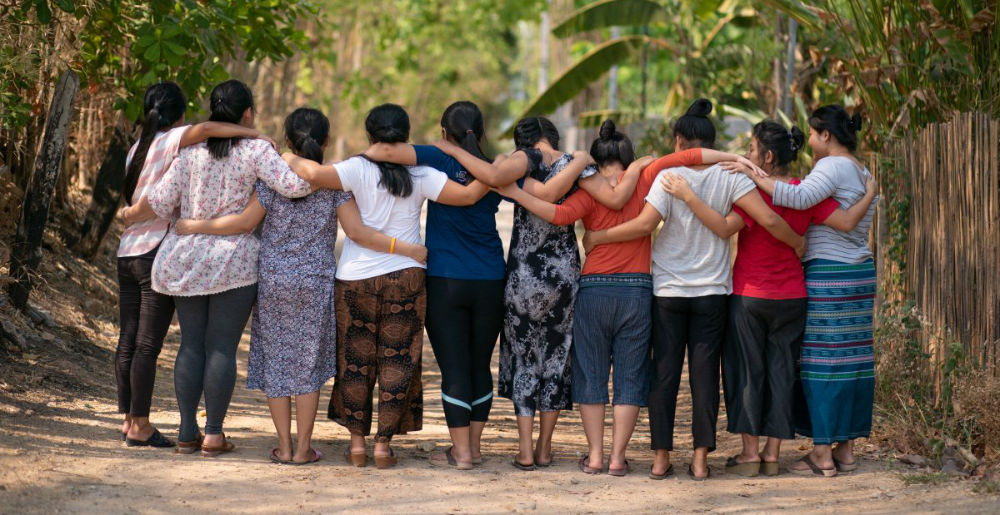
28th Anniversary of KWO Day

On 5 April 2013 KWO celebrated the 28th anniversary of KWO Day. KWO Day took place in four areas of Karen State, Kler Day Trae in Lu Plae Township Pa’An district, Pyae Kah village Taw Oo District, Dooplaya district and Ei Tu Tah refugee camp. KWO Day was also celebrated in an urban area in Thailand and also in refugee camps in Thailand, Mae Ra Moe, Mae La Oo, Umphiem, and Mae La. KWO Central worked together with the Karen people, and Karen leaders at the camp and district levels. KNU leaders, CBO’s, and villagers came together and celebrated KWO Day. During the ceremony, there were several speeches from KNU leaders, CBO leaders, and Karen leaders from the Karen district.

This slideshow requires JavaScript.

In some areas, there were activities and competitions. Activities like singing, painting pictures and questionnaires. Continue reading

Capacity Building Training of Trainer (TOT)

Karen Women Organization Capacity Building Training of the Trainer was held on 12th February to 13th March 2013. There were 24 participants of KWO leaders who came from six districts and seven Karen refugee camps. During the TOT training course there were some topics that covered such as; KWO Constitution and work of the community, Project accounting , KWO overall financial system , Child rights and protection ,Women’s protection and rule of law, Documentation ,Women leadership skills ,Letter writing and  Mine risk awareness training.

TOT pic 1Participants gained many valuable skills at the TOT training. Not only were participants able to gain practical skills like documentation, letter writing, and financial report and receipt preparation, but they also developed skills on how to keep their community and themselves safe, informed, and empowered.

TOT pic 3 TOT Pic 4 TOT pic 2One of the most valuable topics, according to participants, was women’s protection and rule of law. Too often in Karen communities women are the victims of sexual assaults and they do not know how to report the crimes. During TOT trainers learned about the legal rights of women and how to protect women who have been victimized, empowering them to stand up for themselves and other women in the community. TOT graduates will now take this information to their communities and inform other women, promoting the protection of women and rule of law.

KWO Magazine in Skaw Karen

KWO puts out a quarterly magazine in Skaw Karen which are distributed through out the 7 Karen refugee camps and 7 districts.  Each magazine is passed between refugees being read by multiple people.  It is just one way we seek to keep our community up to date and informed.

KWO Magazine (2) KWO Magazine

Use this link if you’d like to download or read our magazine: KWO Magazine Volume 2 Issue 10

KWO 6th Congress Short Movie


Statement of Karen Women Organization’s 6th Congress

KWO 6th Congress Statement 2013 Burmese Version

KWO 6th Congress Statement 2013 Eng Version KWO 6th Congress Statement 2013 Karen Version_Page_1

Use this link if you’d like to download or read it.

KWO 6th Congress Statement 2013 Burmese Version

KWO 6th Congress Statement 2013 Eng Version

KWO 6th Congress Statement 2013 Karen Version

KWO Chair Person Speech at Karen National Day.

KWO Chair Person Speech at Karen National DayKWO Chair person speech


Use this link if you’d like to download or read it. KWO Chair person speech

Karen Women’s Seminar results in new organization: Karen Women for Peace

Responding to Karen Women Participation as provided in UNSCR 1325
Date: 28th, November 2012

The first Karen Women Seminar was successfully held from 24th to 26th of November 2012. The meeting was attended by more than 40 Karen women who are working in a wide variety of fields including education, health, social work, emergency assistance, environment, human rights and women rights.

During the seminar, we discussed United Nations Security Council Resolution 1325 regarding women participation in the peace process, and analyzed Karen women’s involvement in the current peace process. In addition, we planned future activities with the intention to encourage the continuation of women’s active participation in the ongoing peace process.

Thramu Paw Gay Khu, the General Secretary of Federation of Trade Unions – Kawthoolei said that “This is the first time Karen women from various geographic areas have come together to consult and discuss various issues related to women participation in the peace process. We have seen that many women are motivated to take a more active role in the leadership and decision making process. We also came to the unfortunate realization that most of our Karen women are still marginalized and their views are all too often being ignored. I felt this seminar provided a safe space for many women to share their difficult experiences and support each other so we all have more resilience to keep working of behalf of Karen women and our community.”

As a result of the seminar, a working group called “Karen Women for Peace” was established to enhance and improve cooperation among committed Karen women to constructively participate in the peace process. Moreover, an agreement was also made to organize another women’s seminar next year.

Contact- Nan Dah Eh Kler – +66 857269291

Karen women’s seminar press in Burmese final

Karen Women Seminar Press statement Karen Version, 2012

Karen People’s Forum Statement and Press Release Regarding the Peace Proces and Mega Development Projects


Use this link if you’d like to download or read it.

Karen People’s Forum Statement _Burmese_

Karen People’s Forum Statement (English)

Karen People’s Forum Statement (Karen)

Press Release (English)

Press Release (Karen)

Press Release _Burmese_


Karen Community Based Organisations’ Position on Peace Funds

Statement by KCBOs regarding Peace Funds in Burma (July 2012)

Karen Community Based Organisations’ Position on Peace Funds
24th July, 2012
The undersigned Karen community-based organisations working on relief, education, healthcare, women’s rights, human rights, youth development, environmental protection, community development , and sustainable livelihood, among other issues, are concerned about the current lack of transparency and community involvement in the Myanmar Peace Support Initiative (MPSI). We are grateful that Norway has shown concern and a willingness to try to help move peace forward here. We are asking for improvements so this Initiative can make the type of contribution in that effort that everyone wants it to.
We are fully committed to peace in Burma. Peace funds are not a substitute for and should not undermine a comprehensive peace process. We believe that Peace Funds that are transparent, accountable, and have the informed participation of both local communities and community-based organisations working across a range of sectors can help advance our shared agenda for peace in Burma. The MPSI has, to date, failed to meet those standards. For example, failure to consult local communities has resulted in infrastructure development being targeted at areas villagers do not want to relocate, because they will be unable to access their agricultural land. CBO’s were not given adequate information nor opportunity to be legitimately consulted regarding the MPSI. Given those problems, we ask MPSI and other proponents of donor-driven peace funds not to undermine our peace process, but rather to move to a more inclusive and transparent process. MPSI should not take shortcuts or sow division within our leadership and our community in a bid to rush the deployment of funds. We understand your sense of urgency, but this process is too fragile to easily survive major mistakes that can be avoided.
We call on the MPSI and other peace fund proponents to:
1. Stop their current activities for long enough to review their process and procedures for implementation.
2. Immediately release the fund design documents including the local languages translations. These documents should include sector targets, criteria, plans, etc.
3. Issue clear rationales for how each of the projects supported by the funds will contribute to conflict resolution.
4. Develop and release project risk analysis and mitigation, and ensure that accessible monitoring and accountability mechanisms are in place.
5. Develop and execute a robust consultation strategy both with local community members and with community-based organisations.

Contact person:
Saw Albert: + 66 821625199
Nan Dah Eh Kler: + 66 857269291

KWO positions and concerns regarding refugee return


Refugees Participation:

  1. Refugee return should be voluntary and must be with the full consent of refugees. They should not be forced to return.
  2. The return must be full of dignity and respect of refugees.
  3. The planning of our return must include our active participation and views.
  4. We would like to return in groups with our organizations, structure and with a good detailed plan.
  5. Training and awareness must be given to both groups of people (refugees and local people) to understand each other and promote smooth integration.
  6. Women representatives, particularly KWO,  must be systematically included in the planning of refugees return.
  7. There must be recognition of women’s leadership and their contribution to the community from now until we return home.
  8. We do not want to be discriminated against when we return.

Physical Security:

  1. Military camps must withdraw first from our villages before we go home.
  2. Only when military camps that are located close to our farms, orchards and roads withdraw, we will not be afraid to go back.
  3. Land mines must be removed first where we will return and where we will travel and work before we go back.
  4. There must be assessment of villages or places where refugees want to return to for access to education, health and livelihoods. Only when these basic services are available we will return home.
  5. Human rights violations must stop. Violations such as sexual abuse, forced labor, extortion, killing, destroying of our farm and orchards, must stop before we will we dare to go back.
  6. There must be nationwide ceasefire and end of all attacks of any ethnic people. Otherwise we do not trust the government and dare not to return home.
  7. IDP’s should be given priority to return and reintegrated before refugees return
  8. We want refugee return to take place first with one camp or group as a pilot case, and move to other camps if the return goes smoothly.
  9. Karen leaders and Burmese leaders must have a peace agreement which particularly focuses on refugee return and guarantees our rights. There must be law enforcement to protect these rights first before we return.
  10. During our return vulnerable people such as pregnant women, mothers with new born babies, sick people, elderly, disabled people, must receive special care.
  11. For the whole process of the refugee return, prevention, protection, and safety of women must be guaranteed and protection mechanisms must be put in place. (eg. If there is sexual harassment or abuse taking place, there should be mechanisms in place for reporting and the prompt handling of cases. )
  12. During the return of the refugees there must be monitoring groups including international monitoring groups.
  13. There must be good communication and media access so that information can spread easily throughout our returning process.

Legal security

  1. Certificates in camps that are related to education, health, livelihoods and others must be recognized so that we will be able to use them when we return.
  2. If we do not have land to farm and work, we cannot go back yet. Our land issues must be resolved first so that we have places to go back to and can stay and work.
  3. There must be laws for refugees to reclaim their lands.
  4. There must be good “rule of law” that is in line with international law and with enforcement, in our country before we go back.
  5. The community services structure must be strengthened before we go back so that when we return we can integrate easily.
  6. When we arrive back to our home, we must be treated equally and we should be able to travel freely as citizens.

Materials Security

There must be full support for our basic needs and this support must be for long-term until we are able to stand by ourselves.

United Nations Convention Relating to the Status of Refugees (1951)

International Law and Principles on Repatriation

Principles Relating to Return, Resettlement and Reintegration

Principle 1

a) Refugees to return voluntarily

b) Refugees return must be in safety

c) Refugees return with dignity, to their homes or to resettle voluntarily in another part of the country

d) Full participation of refugees in planning and management of the return, resettlement and reintegration

Principle 2

a) Refugees should not be discriminated against because of displacement

b) Refugees returning have the right to fully participate in public affairs

c) Refugees have the right to equal access to public services

d) Refugees have the right to recover property and possessions

e) Refugees have the right to obtain appropriate compensation and just reparation for property and possessions lost

Principle 3

a) Refugees have the right to international humanitarian aid which provides assistance to refugees return, resettlement or reintegration.