Special Education Training of the Trainer

DSC09934 DSC09974 DSC099567 P1110675

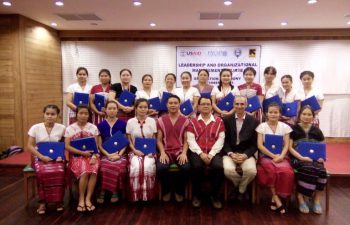
On 1st  March 2013, 20 school directors, trainers, and teachers from Mae Ra Moe, Mae La Oo, Mae La, Umpiem, Nu Poe, Bang Dong Yang, and Suphung in Mae La Camp completed a three week special education Training of the Trainer (TOT) program. Topics included play session planning, classroom management, art, lesson planning, and much more. This was the first time all seven camps came together for TOT. All of the 20 participants are very excited to bring their new knowledge back to their communities.

Supporting 73 Village Nursery Schools This Year

nursery school students 2

We are half way through the school year here and KWO is supporting 73 village nursery schools spread across 5 areas in Karen State, Burma. Many of these students have been displaced by the Burmese military and the long standing civil war.  We are so pleased that this year we have been able to support these schools serving over 3000 Karen children.

The Burmese education system has been terribly underfunded.  A large portion of the Burmese government treasury goes to the military despite the fact that we have no external enemies.  This means parents must pay for their children to attend in the poorest country in South East Asia.  The average level of education in Burma is just 4 years. For areas dominated by ethnic minorities the education level is lower and poverty higher.

This makes our Nursery School project even more important.  Each community builds and maintains their own bamboo or wooden school and forms a nursery school committee to support it and the teacher.  Through a grant from Dave and Kerry Rickards we are able to provide training, a small stipend to the teachers along with some materials and supplies.  Through private donations we provide lunch.  We still haven’t raised all the money we need to feed all 3000 students through the end of the year, but we are happy to have been able to do it so far. We continue to apply for additional funding to fill the gaps.  We have so far raised about 60% of the overall budget including the food. Just $25 feeds one child lunch for the school year.

One 5 year old student spoke the simple truth when he said, “I am happy to go to nursery school because of every day I get snack, lunch, and food. I have a lot of friends in school and we play together. If I did not go to nursery school I would go with my parents to the field.  The field it is not fun for me. In the past when I went with my parents to the field, the insects bit my body. My body got a wound. It itched so much! If I finish nursery school I will go to primary school.”

Nursery School 5

A parent in Noe Poe Htee Moo Hta said, “Because we send our children to nursery school our children look so healthy and fresh, not like before, because they eat, sleep and play regularly. They are growing up quicker than before. If we compare two children’s condition the first one going to nursery school and the second one not, we can see the difference.”  A parent in Do Tha Htu district said, “Because of the nursery school we work in our field free all day from worry. When we send our children to nursery school we get two advantages. First, we go to the field to work not worrying that our children will fall down, swim in the stream, climb the trees, eat unclean foods or get hurt by someone else. Secondly, we see that their condition is better than before. They can read and write the Karen, English, and Burmese alphabet. It is a basic thing they need to go to the primary school. They can sing songs and dance. They have confidence. If someone asks them to stand in front of people and sing, they can do it, they are not afraid anything.”

 We want all our children to have confidence and not be afraid of anything.

Nursery 4

Nursery School 3

A visit to one Karen Women Organization ( KWO ) supported dormitory in Karen State

A visit to one Karen Women Organization ( KWO ) supported dormitory in Karen State

In April 2012, I went with 5 KWO colleagues to Doo Tha Htu district in Karen State. Among other activities we also visited a student dormitory that has been supported for several years through KWO and individual friends. There are 30 students who live full time in that dormitory. During our visit we met with 21 of them (12 girls 9 boys). The other students had gone home to their villagers for the summer school holiday. The students were excited to see us and we were very happy to meet them as well. We sat in a circle at the dormitory carer’s house and we introduced ourselves. We asked the students why they had come to live in this dormitory.The students replied:

  • “There is only a small primary school in my village and I want to continue high school so I came and attend high school in this village. I have no relatives to stay with here so I stay in the dormitories.”
  • “The cost of study is too expensive, and my parents cannot support me and if I do not stay in the dormitory I could not continue my education.”
  • “Some villages where we come from are three hours walk one way. The distance is too far to walk every day so I stay in dormitory.”
  • “Some of us are orphans and we have no one to care for us and so we live in dormitory.”

We also wanted to find out what the students wanted to do when they finished school and what do they dream of. Most students replied:

  1. Teacher
  2. Nurse and Medic
  3. Captain/Commander
  4. Missionary
  5. Working with KWO
  6. Become government worker

This slideshow requires JavaScript.

We also asked them to draw a picture of their dream village of how they would like to see their village one day. They had to think of what kind of development they wanted to see in their villages, they had to think about it and put it into drawing. We gave the students about half an hour and after that each student presented their drawing and explained it to the big group. We noticed in most of their drawings, something in common: We saw in most drawings, the Karen Flag hanging in front of the schools, and there were wells, toilets and good roads in their villages. These are important to them because currently in their villages, there are only few toilets and in the school there is only one toilet, it is for the teachers use. In their villages now in front of the school there is only the Burmese flag, so they would like to see the Karen flag instead of the Burmese one. There is very few or no well in their villages and most villagers use one river to get water and this river is used by both animals and people for bathing and drinking. During the raining season the river floods and there is lots of mud in the river and it is hard for them to drink.

For us from KWO, it was very satisfying to see these young people thinking of water and toilets as important and as essential things in their dream village. It was inspired too, to see Karen flag flying in front of their schools. The school in the village where the dormitory is only goes up to grade eight, not the end of high school. After that they will have to find another school if they want to finish high school. Many students from the village in Karen State have come to the refugee camps along the border to study until they finish high school and have lived in dormitories that KWO support. In the refugee camps, KWO supports currently 16 dormitories with over 600 students from Karen state.

This is our favorite moment to see all dormitory students drawing their ” Dream Village”.

As the school year starts again in May 2012, we are still looking for funding for this dormitory in this village. We rely solely on donations so some years, we do not have enough money to support them, and the KWO at village level has to borrow money to buy food for them. We have to thank Australia Karen Organization (AKO) Women Departments for contributing annually to this dormitory.  The dormitory students also do fund raising themselves. They sell snacks and have luck draws during any community events. They raise chickens to eat at the same time to sell them and buy other food and needs. In 2011 we provided some funding for their building and we were very pleased to see the newly built dorm, which was not completely, finished but was in good condition. We will continue to support this dormitory and continue looking for funding to support children having access to basic education. We would like to thank all individuals who donated money to KWO. We are able to provide support to these children because of your support. We hope you will continue to support us to fulfill the dream of these children.

Written by Naw K’nyaw Paw, Education Program Coordinator, Karen Women Organization (KWO)

$25 will help feed a Karen child at our Nursery Schools for a full year


Click here to DONATE

This slideshow requires JavaScript.

The children in our Nursery Schools in Karen State in Burma need your help.  We know that education is important for people all over the world, especially education of young children. Despite the long standing abuse by the Burmese military Karen communities across Karen State join together to build and support nursery schools for their children.   They gather building materials, construct the school, bring fire wood and other things they can find to help.  There is a community committee of volunteers who run the school. These schools work amid fighting and commonly must relocate to avoid the fighting.

KWO, Karen Women Organisation, has always tried to support the schools with money we raise through grants. Through the generosity of the Dave and Kerry Rickards we have been able to support many children and schools. We pay small stipends for each teacher, about $17 US dollars a month.  We provide training to the teachers, school supplies, basic hygiene supplies for the children.

Unfortunately, KWO  has not been able to raise enough money to supply lunch food to the students. The 3000 students enrolled in these community schools do not always get enough food at home.  For just $25 we can provide an entire school year of supplemental lunch food to one student.  This will let them get the nutrition they need since many families have been separated from their land by the war. The Karen community has been disrupted and abused by years under the dictatorship in Burma.  We hope by supporting these students we are building our future, but we need your help.

Please click here to DONATE the much needed funds to feed these young students.

KWO Magazine in Karen

KWO puts out a quarterly magazine in Skaw Karen which are distributed through out the 7 Karen refugee camps.  Each magazine is passed between refugees being read by multiple people.  It is just one way we seek to keep our community up to date and informed.

Use this link if you’d like to download or read our magazine:  Magazine Vol. 2 Issue 7

Nursery Schools in IDP areas and camps

KWO also runs nursery schools in IDP camps and areas in Karen State inside Burma.  Children’s families have been forced to flee their villages due to conflict and attacks by the Burmese junta.  Despite the circumstances we are able to provide enrichment, nutrition, and care to hundreds of children as well as training for teachers.

Since May 2008, KWO has given financial support to Nursery schools in 5 districts of Karen State: Mu Traw, Du Thu Htu, Doo Pla Ya, Kler Lweh Tu and Pa an. The schools are managed by local KWO staff.

Since 2006, when Ei Tu Hta camp was established, KWO has been supporting the nursery schools for IDP children who live there.  There are 5 Nursery Schools with a total of about 400 children receiving daily lessons and care.

Parents Workshops: Parents of young children in Ei Tu Hta IDP camp were given the opportunity to attend 4 half-day training sessions on early childhood development

Student in Nursery School in Mu Traw District

Teacher and Students in Doo Pla Ya District

2011 Train the Trainers Workshop

 Teacher Training: Teachers in Ei Tu Hta IDP camp are given a 10 day training each year during the April school holidays.

Family Days: In all of the schools in the Ei Tu Hta IDP camp project, and in Mae La Oo and Mae Ra Moe Refugee camps, we conducted short opening and closing ceremonies each school year, plus a family day to celebrate the festive season in December. These were designed to encourage family involvement and included speeches by staff and community leaders and performances by the children.

Teacher Training KWO trainers in refugee camps cannot easily reach the Nursery School teachers in Karen State. Currently we provide 10  days of training, once per year. The area coordinators then returned to their districts and provided training to the teachers in that area, either through a central group training session, or by visiting individual schools, or a combination both.

Women’s Empowerment and Vocation Training Project (IDP Areas)

Goal: To educate women in IDP areas and give them vocational and life skills training, building their confidence and skills to work for the community and increase women’s participation in all levels of decision-making.

This project for women among the Internally Displaced People in Karen State has been running since 2005 in 6 districts. There are two parts to the project:

Women’s Empowerment: This project aims to provide skills and knowledge training to local KWO leaders inside Karen State and build their capacity in community management. Over the course of the project, KWO has trained 10 permanent trainers, and also provides refresher courses for them when necessary. In 2009-2010, those 10 permanent trainers conducted 9 training sessions on Leadership and Management skills for IDP women.

Basic Level:  The training instructed participants in: forms for organizational reporting and financial reports, customary law, women’s protection

Advanced Level: designed for senior district leaders the advanced level training covered: the KWO constitution, basic accounting,report writing, office management, leadership skills

The majority of participants in the training sessions were Karen women who live in the IDP areas of Karen State, Burma, aged between 18 and 60. All of them are KWO position holders in their areas. A small number of male leaders from each community also participated.

Through this program KWO empowered 199 local women through 10 KWO-trained representatives during 9 training workshops

Vocational Skills Training:

KWO conducted vocational skills training in loom weaving and in sewing.

  • 5 loom weaving training courses were conducted with 21 participants across 3 districts. At least 12 big looms were provided to those communities.

  • 6 sewing training courses were conducted across the two-year period, involving 43 participants. 23 sewing machines were given to communities in four districts.

The women learnt basic skills and practiced making garments. These skills were later used when commissioned by other KWO projects to make clothes and other goods. This allows women to earn income for their family, and gives the communities a valuable skilled worker. Communities were also provided with equipment (big looms and sewing machines) to be owned and used collectively, and so they can continue to develop income revenue.

Conducted 5 loom weaving training courses and 6 sewing training courses for participants across 4 districts of Karen State

Capacity Building

Capacity Building Project

Goal: To support and strengthen KWO’s capacity to provide essential services to the Karen refugee and village communities.

In order to ensure the effective operation of KWO’s work in the refugee camps, KWO organizes capacity building training for KWO staff and members. These activities have been run regularly for ten years, with various frequency and levels of funding.

In 2009, KWO renewed its efforts to increase the skills and knowledge of KWO staff, members and position holders at all levels of the organisation. Since 2005 in the refugee camps, there has been a high turnover in KWO due to families departing for resettlement and many of the remaining women in camps who were subsequently elected into KWO positions of responsibility, have less management experience and had received less training. In response to this the Capacity Building Project has redoubled efforts to provide appropriate and regular skills and knowledge training.

12 capacity building modules were run for KWO staff in the refugee camps and town offices. All the modules contribute to staff and members being able to make better decisions and work more effectively, enhancing the quality of their support to thousands of people.  The modules include: Leadership Training, Report Writing and Accounting, Human Rights and Gendertraining, Democracy and Leadership, SGBV community consultation, Women’s Protection, Basic Law and Social Services, Documentation and Writing, Project Proposal, Budget and Report Writing, Financial Procedures, Income Generation skills for town based staff.  This program built the capacity of 1,872 women in decision-making positions through 12 training courses.

Emerging Leaders School (ELS)

The KWO Emerging Leaders School (ELS) was started in 2008. The course ran 2 times for 10 months each time, between April 2008 and March 2009 and a similar period in 2009-2010.  The project aims to provide a higher level of education for young women, than the KYWLS curriculum and to prepare the students more for a leadership role, especially in advocacy work. There is a sister course run by the WLB in Chiang Mai.

14 students participated in the 2008-2009 school year and another 14 in the 2009-2010 school year (including 6 and 9 KWO staff members in 2008-2009 and 2009-2010, respectively). Students travelled from refugee camps, and inside Karen State to Thailand to take part in the course. The students included representatives from KWO & other organisations such as CIDKP, KTWG, KESAN, KORD, KYO, KSNG, KNU and other networks inside Burma. The young women were chosen by their organisations as having demonstrated ability and promise. All women who completed the course are now working in their respective organizations.

There were 3 core teachers in each year, plus 1 foreign volunteer English teacher and a selection of local guest teachers. In 2008-2009, the ELS also had a computer teacher. Teachers included foreign volunteers, several KWO staff members, and (in 2009-2010) the graduates of the previous year.

The program provided an opportunity to advance the women’s critical thinking, public speaking and presentation skills. Topics covered through the program included:

  • Introduction to Gender

  • History of Burma & the Karen (presented by a guest teacher)

  • Democracy

  • Public Speaking

  • Federalism (presented by a guest teacher)

  • Economics and development (presented by a guest teacher)

  • Policy Making

  • Lobbying Skills

  • UN Principles and Bodies

  • Human Rights Conventions

  • Humanitarian Law

  • Southeast Asia

  • Working with the media (presented by a guest teacher)

  • Asian Countries and their policies towards Burma

  • Lessons for Burma from Country Case Studies

  • The European Union and western countries’ policies on Burma

  • Burmese Politics Today

  • Electoral systems and quotas